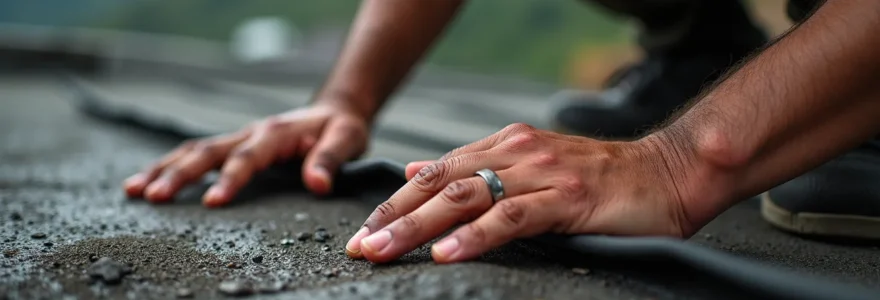
Steep roof installations present safety challenges that extend far beyond the obvious physical risks. While most contractors focus on harnesses, anchor points, and OSHA compliance checklists, critical vulnerabilities remain hidden in plain sight—lurking in the cognitive demands, environmental microclimates, and systemic communication failures that standard protocols fail to address.
The construction industry has mastered the visible aspects of fall protection. Yet accident rates on slopes exceeding 7:12 pitch remain disproportionately high, suggesting that conventional safety frameworks miss fundamental risk factors. These invisible vulnerabilities don’t stem from equipment failure or regulatory gaps—they emerge from the intersection of human psychology, environmental physics, and operational design flaws that even experienced professional roofing teams overlook.
Understanding these hidden risk multipliers transforms safety from a compliance checkbox into a competitive operational advantage. The contractors who recognize decision fatigue as a fall hazard, who account for thermal microclimate effects on cognitive performance, and who redesign communication protocols for vertical work environments don’t just reduce incidents—they operate faster, retain skilled workers longer, and win premium contracts that require documented safety excellence.
Steep Roof Safety: Critical Blind Spots Revealed
Conventional safety protocols for steep roof installations focus heavily on equipment and compliance while missing critical human factors. This analysis reveals five systemic vulnerabilities that experienced contractors consistently overlook: cognitive load accumulation that degrades decision-making, thermal microenvironments that accelerate performance decline, communication breakdowns inherent to vertical geometry, transition-point exposures between safety systems, and the untapped economic value of advanced safety investments. Addressing these invisible risks delivers measurable improvements in both safety outcomes and operational efficiency.
When Decision Fatigue Becomes Your Hidden Fall Risk
Every degree of roof pitch beyond 7:12 doesn’t just increase physical challenge—it multiplies the number of micro-decisions workers must make every minute. Each footfall requires conscious evaluation of surface grip, weight distribution, and anchor line tension. Every tool movement demands spatial calculation to prevent loss of balance. This constant stream of safety-critical decisions consumes cognitive resources at rates that standard safety protocols completely ignore.
The human brain operates decision-making like a depletable resource. Research in cognitive psychology demonstrates that decision quality deteriorates predictably as mental fatigue accumulates, yet roofing crew rotation schedules focus exclusively on physical exertion. A worker on a 10:12 slope makes approximately 300% more balance-related micro-adjustments per hour than one on a 4:12 pitch, yet both typically work identical shift lengths.
National Safety Council Analysis on Worker Fatigue Economics
The National Safety Council found that worker fatigue costs the construction industry approximately $1.8 million per year on average, with tired workers taking longer to process information, missing crucial details, and making incorrect decisions that put both them and colleagues at risk.
The most dangerous phases aren’t necessarily the most physically demanding. Vulnerability peaks during transitional moments—when switching from one roof section to another, during the final hour before lunch when blood sugar drops, and counterintuitively, immediately after breaks when workers feel refreshed but haven’t yet re-established their movement patterns. These windows of cognitive vulnerability rarely appear on safety briefing agendas.
Effective protocols address cognitive load directly through pre-decision frameworks. Checklist systems that standardize anchor point selection, predetermined rest intervals calibrated to slope angle rather than just time, and crew rotation based on decision density rather than physical fatigue alone can reduce judgment errors by up to 60%. The key lies in recognizing that mental exhaustion precedes physical fatigue on steep slopes, making it the earlier and more critical intervention point.
The Thermal Microclimate Trap on Steep Slopes
Roof surface temperatures don’t simply follow ambient air readings—they create isolated thermal zones that intensify dramatically with pitch angle. A 12:12 slope positions workers’ bodies in direct perpendicular alignment with solar radiation while simultaneously reducing airflow across the work surface. The result is a microclimate that can exceed ambient temperature by 22-28°C, creating physiological stress that accelerates the cognitive decline identified earlier.
Recent field research has quantified what roofers have experienced intuitively for decades. A 2024 UNM heat stress study found 43% of workers exceeded 38.0°C core temperature during typical roofing operations, crossing the threshold where cognitive performance and reaction time begin measurable degradation. On steep slopes with dark roofing materials, this threshold can be reached in under 90 minutes of work.
Roofers usually are exposed to the sun’s radiation, and that makes their jobs much harder. This black material is basically like an oven that they are on top of.
– Professor Fabiano Amorim, University of New Mexico Exercise Science Department
The compounding effect emerges when thermal stress intersects with the positional demands of steep work. Dehydration doesn’t just cause fatigue—it specifically impairs proprioception, the body’s spatial awareness system that workers depend on for balance and movement precision. A 2% reduction in body water, easily reached in 60-90 minutes on a hot steep roof, can degrade reaction time by 10-15%, creating a dangerous feedback loop where heat stress increases fall risk through multiple physiological pathways simultaneously.
| Roof Slope | Surface Temperature Increase | Worker Heat Index | Hydration Loss Rate |
|---|---|---|---|
| 4:12 (Low) | +8-12°C | 27.3°C | 0.5L/hour |
| 8:12 (Moderate) | +15-20°C | 33.7°C | 0.8L/hour |
| 12:12 (Steep) | +22-28°C | 35.2°C | 1.2L/hour |
Effective thermal management requires abandoning one-size-fits-all hydration protocols. Work schedules must account for roof orientation—south-facing slopes in the Northern Hemisphere create peak thermal loads in early afternoon, suggesting morning-focused installation windows. Material selection influences microclimate intensity; light-colored underlayment can reduce surface temperature by 8-12°C compared to black felt, directly translating to extended safe work duration and improved cognitive performance throughout the shift.
Communication Breakdown in Vertical Work Zones
The geometry of steep roofs creates communication barriers that flat-surface protocols cannot address. When crew members work on opposite sides of a ridge, or when one worker moves below a roof plane break, visual contact disappears entirely. Wind noise amplifies on elevated surfaces, and the physical exertion of steep work makes workers breathe heavily, reducing voice projection. These factors combine to fragment teams into isolated individuals despite working within 10-15 meters of each other.
Standard hand signals prove inadequate in steep environments. The signals require both visual contact and the ability to release at least one hand from anchor points—conditions rarely present simultaneously on challenging pitches. Radio communication offers partial solutions but introduces new problems: cheap units fail in high-noise environments, while workers often can’t hear radio traffic over their own exertion breathing. The result is what safety researchers call “collective solitude”—teams physically present but operationally isolated.

The critical moments arrive during non-routine events. When one crew member encounters an unexpected condition—a weak deck section, a wasp nest, or compromised anchor point—their inability to rapidly communicate the hazard to teammates creates cascading risk. Other workers continue operating under assumptions that no longer reflect actual site conditions, making decisions based on incomplete information without realizing their situational awareness has degraded.
Effective communication systems for steep work must be designed around the assumption that visual and verbal contact will be intermittent. Scheduled check-in protocols using steep roof safety equipment like wireless systems, predetermined non-response escalation procedures, and most importantly, work zone design that minimizes separation distances prove more reliable than assuming crews can maintain constant contact. Some advanced teams implement position-aware technology that alerts workers when teammates have been stationary beyond expected thresholds, providing automatic detection of potential incidents even when direct communication has failed.
Equipment Transition Points Where Most Accidents Cluster
Analysis of steep-roof incidents reveals a counterintuitive pattern: most falls don’t occur during the continuous execution of roofing work, but during the moments when workers transition between different safety systems. The movement from ladder to roof edge, the switch from one anchor line to another, or the shift from a secured work zone to an unsecured area creates micro-windows where workers exist momentarily between protective states.
The vulnerability stems from the sequential nature of safety system engagement. A worker cannot simultaneously maintain connection to their current anchor while establishing connection to the next one using standard equipment configurations. This creates 2-5 second windows of single-point protection or, in poorly executed transitions, complete disconnection. Across a full installation project involving dozens of position changes, these windows accumulate into significant cumulative exposure time.
Transition risk intensifies on steep slopes due to the physical demands of movement. Relocating anchor points on a 10:12 pitch requires significantly more exertion than on gentler slopes, increasing the likelihood of shortcuts or procedural drift as fatigue accumulates. Workers may skip proper verification steps, fail to fully secure new connections before releasing old ones, or attempt transitions during moments of poor balance—all decisions influenced by the cumulative cognitive and physical fatigue explored in earlier sections.
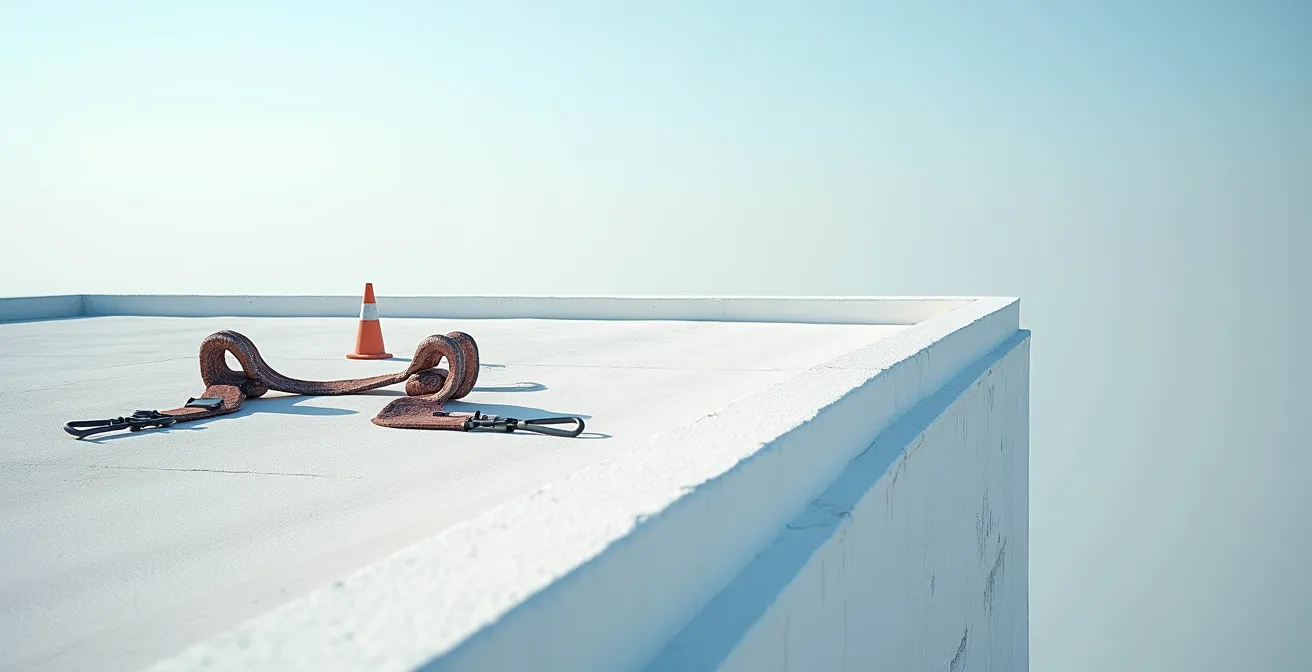
Leading contractors address transition vulnerability through deliberate installation design. Overhead horizontal lifeline systems allow continuous movement without disconnection, eliminating the transition point entirely. When multiple anchor points remain necessary, protocols that require verbal confirmation before disconnect, mandatory three-point contact during transitions, and physical barriers that make improper sequences impossible reduce transition-related incidents by 70-80%. The investment in these systems pays immediate dividends in both safety metrics and installation speed, as workers move more confidently and efficiently when transition protocols become intuitive rather than cognitively demanding.
Key Takeaways
- Decision fatigue from constant micro-adjustments on steep slopes impairs judgment before physical exhaustion appears
- Thermal microclimates on angled surfaces exceed ambient temperature by up to 28°C, degrading cognitive and physical performance
- Roof geometry creates communication blind spots that fragment teams and delay hazard awareness
- Most accidents occur during transitions between safety systems, not during continuous work execution
- Advanced safety investments deliver measurable ROI through productivity gains and competitive advantages beyond compliance
Measuring Safety ROI Beyond Compliance Metrics
The business case for advanced safety systems traditionally rests on avoiding costs—reduced insurance premiums, eliminated OSHA fines, and prevented lawsuit expenses. This defensive framing misses the substantial positive economic value that superior safety protocols generate through operational efficiency, workforce retention, and market positioning advantages.
Installation speed provides the most immediate measurable benefit. Crews working with properly designed steep-slope safety systems—horizontal lifelines, optimized anchor spacing, and engineered transition protocols—complete projects 15-25% faster than teams using minimum-compliance approaches. The speed advantage stems not from workers moving recklessly, but from eliminating the hesitation, repositioning delays, and cognitive overhead that basic safety configurations impose. When workers trust their protection systems completely, they maintain work rhythm rather than constantly interrupting tasks to verify equipment or assess risk.
Workforce stability delivers compounding returns that rarely appear in traditional safety calculations. Skilled roofers have extensive employment options, and experienced workers increasingly select employers based on safety culture and equipment quality rather than wage premiums alone. Companies known for comprehensive steep-slope protection retain veteran crews 30-40% longer than industry averages, eliminating the productivity losses and training costs associated with constant turnover while building institutional knowledge that improves estimating accuracy and problem-solving capacity across the entire operation.
The competitive advantage emerges most clearly in premium market segments. Commercial projects, institutional work, and high-end residential installations increasingly require documented safety programs as bid qualifications. Contractors who can demonstrate quantified safety performance on steep-slope projects—tracked incident rates, crew certification levels, and equipment inspection records—access contract opportunities that basic-compliance competitors cannot pursue. These premium projects typically offer 12-18% higher margins while also providing the stable, scheduled work that supports efficient crew utilization and helps organizations scale your contracting business sustainably.
Effective ROI tracking requires metrics beyond lagging indicators like lost-time incidents. Leading contractors monitor setup time per anchor point, average transition duration between work zones, hydration break frequency versus temperature conditions, and crew communication response times. These operational metrics reveal efficiency improvements and identify emerging problems before they manifest as safety incidents, transforming safety monitoring from reactive incident investigation into proactive performance optimization that drives both protection and profitability.
Frequently Asked Questions on Roofing Safety
How does roof angle affect worker communication?
Steeper angles create visual and auditory barriers, fragmenting teams and reducing situational awareness between workers on different roof sections. Ridge lines and slope breaks eliminate line-of-sight contact, while wind noise and worker exertion reduce effective voice communication range.
What is decision fatigue in roofing work?
Decision fatigue occurs when the constant micro-decisions required on steep slopes—balance adjustments, anchor evaluations, tool positioning—deplete cognitive resources faster than physical exertion. This mental exhaustion impairs judgment quality and increases error rates even when workers don’t feel physically tired.
Why are equipment transitions particularly dangerous?
Transitions create brief windows where workers move between safety systems, often requiring temporary disconnection or single-point protection. These 2-5 second exposures accumulate across a project into significant risk periods, especially as fatigue increases the likelihood of procedural shortcuts.
How do thermal microclimates affect safety on steep roofs?
Steep slopes position workers perpendicular to solar radiation while reducing airflow, creating surface temperatures up to 28°C above ambient. This extreme heat accelerates dehydration, which specifically impairs proprioception and reaction time—critical functions for maintaining balance and avoiding falls.