
International companies seeking to hire Swiss-based talent face a strategic choice: incorporate a local legal entity—typically requiring CHF 20,000 to CHF 40,000 in upfront costs and a four-to-six-month timeline—or engage an Employer of Record (EOR) provider to establish compliant employment relationships within days. The EOR model has gained traction among organizations requiring rapid market entry without the administrative burden and capital commitment of traditional entity establishment.Switzerland’s federal structure compounds this decision. Each of the country’s 26 cantons maintains distinct tax rates, and employment administration requires navigation of overlapping federal and cantonal regulations alongside a three-pillar social insurance system unfamiliar to most international HR teams. The most frequently observed challenge involves underestimating the operational complexity of Swiss payroll compliance—particularly the coordination of AVS/IV contributions, occupational pension enrollment, and source tax withholding across cantonal jurisdictions.
This analysis examines the legal architecture, operational workflow, and compliance framework of EOR services in Switzerland. It addresses the fundamental mechanics of how EOR providers assume statutory employer obligations while client companies retain operational control, and clarifies when this solution delivers strategic value compared to alternative employment structures.
An Employer of Record (EOR) is a specialized legal entity that assumes all statutory employer obligations for workers on behalf of a client company operating in Switzerland without a local entity. The EOR becomes the legal employer designation responsible for employment contracts, payroll processing, tax withholding, and mandatory social insurance contributions, while the client company retains full operational control over daily work direction, performance management, and business objectives.
Breaking Down the Employer of Record Model
The EOR structure creates a triangular legal relationship: the client company identifies and selects the candidate, the EOR provider executes the employment contract as the legal employer, and the employee performs work under the client company’s operational direction. This arrangement enables international businesses to hire Swiss-based professionals without incorporating a GmbH, AG, or other local legal entity—eliminating incorporation legal fees, notary costs, and the ongoing administrative overhead of maintaining a registered Swiss presence.
Swiss regulatory frameworks generally mandate that every employment relationship designate a clear legal employer responsible for executing compliant contracts, calculating and remitting payroll taxes, enrolling employees in mandatory social insurance programs, and fulfilling cantonal reporting obligations. When a foreign company lacks a Swiss entity, these obligations cannot be directly satisfied. The EOR provider steps into this gap, assuming the employer-of-record position while the client company continues to manage the employee’s day-to-day responsibilities, assign projects, conduct performance reviews, and make all substantive business decisions. For organizations evaluating service providers and seeking comprehensive implementation guidance, consult this website for detailed specifications on Swiss-tailored EOR solutions addressing cantonal compliance complexity and multi-pillar social insurance administration.
The value proposition becomes particularly pronounced in Switzerland due to the country’s unique cantonal autonomy structure. A company hiring employees in Zurich, Geneva, and Basel must navigate three distinct cantonal tax systems, each with different withholding rates, filing procedures, and compliance calendars. The alternative—establishing a Swiss entity—requires initial capital injection (minimum CHF 20,000 for a GmbH), securing a registered office address, appointing a resident director, and maintaining annual financial audits and corporate filings. Established best practice typically requires four to six months to complete this process, during which hiring remains on hold.
From Candidate Selection to Monthly Payroll: The Operational Flow
Understanding the operational sequence clarifies what the EOR provider administers versus what the client company controls. The process begins well before any legal employment relationship exists and continues through the entire employment lifecycle, spanning recruitment, onboarding, and ongoing monthly administration.
Sourcing and Candidate Selection
The client company retains complete autonomy over hiring decisions—identifying candidates, conducting interviews, evaluating qualifications, and determining compensation offers. The EOR provider plays no role in candidate selection. Once the client company decides to hire a specific individual, it communicates the agreed salary, position title, start date, and negotiated benefits to the EOR provider. This division ensures the client company maintains its organizational culture and talent standards while the EOR handles legal employment infrastructure.
Contract Preparation and Legal Onboarding
The EOR provider drafts a Swiss-compliant employment contract reflecting the terms the client company negotiated. According to Switzerland’s Code of Obligations, employment contracts must specify key terms including employee and employer names, start date, job function, and salary. The contract establishes the EOR as the legal employer while clarifying that the employee will perform work under the client company’s operational direction.
The onboarding phase encompasses several parallel administrative workstreams. For non-EU/EFTA nationals, work permit processing begins immediately. The Swiss Federal Council’s 2026 quota allocation permits a maximum of 8,500 qualified third-country workers annually, with employers required to demonstrate that no suitable Swiss or EU/EFTA candidate could be recruited.
Simultaneously, the EOR registers the employee with Switzerland’s multi-pillar social insurance system: AVS/IV first-pillar enrollment, BVG second pillar occupational pension fund selection (mandatory for employees earning above the statutory threshold), and cantonal unemployment and accident insurance registration. Tax domicile registration with the cantonal tax authority establishes the withholding framework. This entire onboarding sequence typically requires 10 to 15 business days when documentation is complete and no work permit complications arise.

; HR administrator shows different age and professional attire style creating visual diversity. All visible form text and document headings in English. Palette: warm neutrals, soft blues from forms, professional office tones. Medium shot capturing both individuals and documentation context. –no metaphor, no symbolic object, no abstract composition, no infographic style, no conceptual diagram, no triptych, no split image, no collage, looking at camera, distracted expression while performing task, blurred face, garbled text, nonsensical text, fake words, duplicated text, document as main subject occupying most frame, 3d render, floating hand, disconnected limb, tilted screen, upside-down interface, identifiable platform branding, large empty side margins”>
Ongoing Employment and Payroll Administration
Once the employment relationship begins, the EOR provider manages the monthly payroll cycle while the client company directs the employee’s work activities. Each pay period, the client company approves worked hours and variable compensation, then transmits this information to the EOR. The provider calculates gross-to-net salary applying cantonal tax withholding rates, deducts mandatory social insurance contributions, and processes payment.
The 2026 contribution structure, per University of Zurich payroll regulations, establishes a combined AVS/IV/EO rate of 10.6% of gross salary—split equally with 5.30% employer-funded and 5.30% employee-deducted. Unemployment insurance (ALV) contributions stand at 1.10% each, capped at CHF 148,200 annually. Second-pillar BVG contributions apply to employees above the entry threshold, with employers funding at least half the premium.
The EOR remits these deductions to authorities, maintains regulatory compliance, administers statutory vacation entitlements (four weeks annually for employees over age 20), and manages benefits. The client company remains responsible for performance management, work assignment, and operational employment aspects.
Navigating Swiss Employment Compliance Through EOR Expertise
Switzerland’s compliance landscape stands apart from most European jurisdictions due to its federal structure granting significant regulatory autonomy to cantonal governments. An employer hiring staff in multiple cantons must adhere to 26 potentially distinct tax codes, each with unique withholding tables, filing deadlines, and documentation requirements. This fragmentation creates administrative complexity requiring ongoing monitoring of regulatory updates across multiple jurisdictions simultaneously.
The three-pillar social insurance architecture adds further layers. The first pillar—AVS, IV, and EO—operates at the federal level with uniform contribution rates. The second pillar, governed by the BVG/LPP framework, mandates occupational pension enrollment for employees earning above the minimum threshold, but each employer selects from dozens of pension fund providers offering different investment strategies and fee structures. EOR providers maintain relationships with multiple pension funds, navigate enrollment criteria, and ensure contribution remittances reach the correct institutions on schedule.
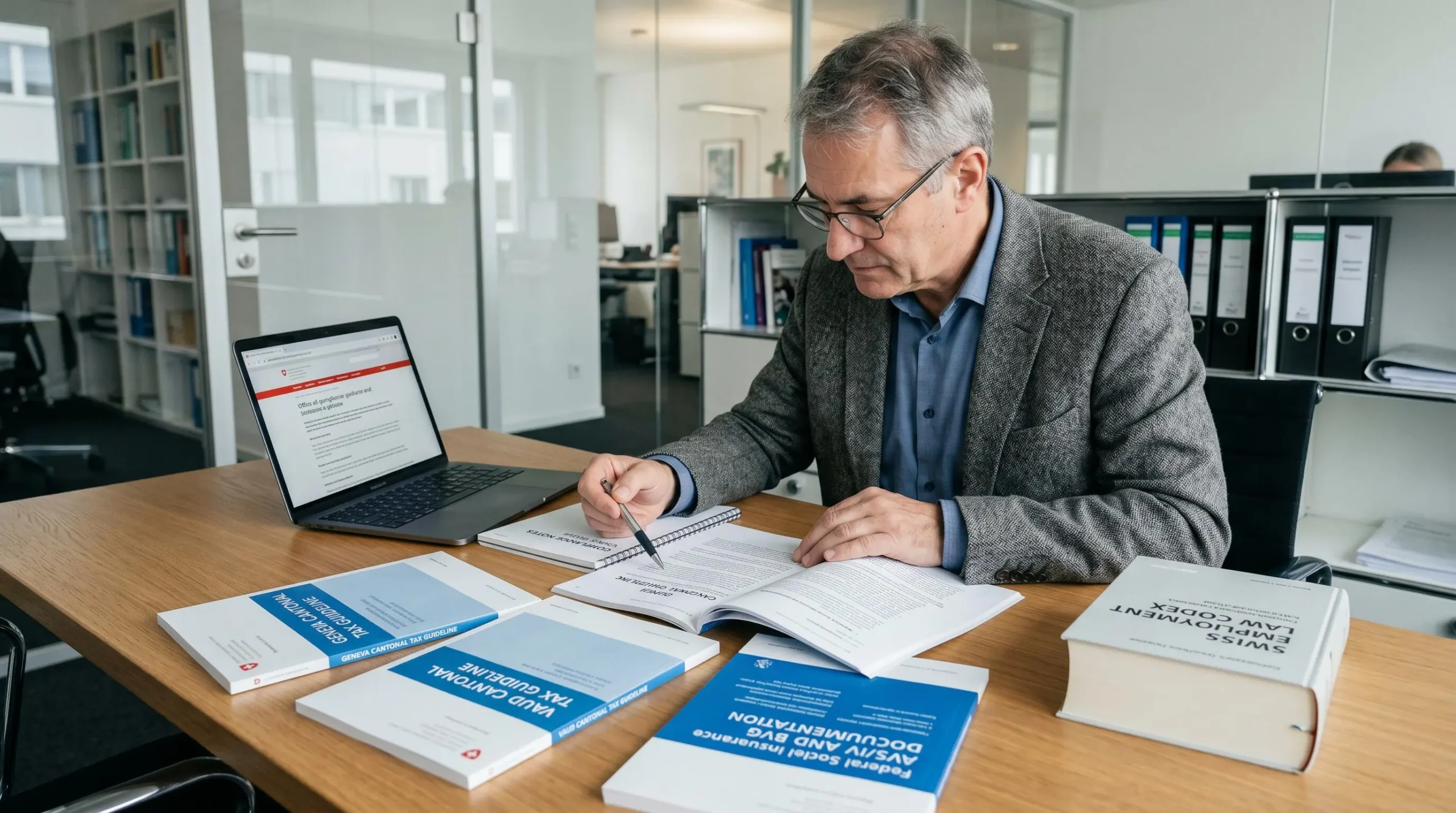
Work authorization procedures introduce additional variables. EU and EFTA nationals benefit from bilateral agreements granting streamlined access to the Swiss labor market, though registration requirements still apply. Third-country nationals face quota-based restrictions—the 8,500 annual permits allocated for 2026 represent hard ceilings constraining hiring during peak recruitment. Employers must demonstrate that no qualified Swiss or EU/EFTA candidate could fill the role, requiring structured documentation of recruitment efforts. EOR providers familiar with cantonal migration procedures manage this application process, though approval remains subject to quota availability and economic needs assessment.
Regulatory updates occur with frequency that challenges HR teams unfamiliar with Swiss legislative calendars. Social insurance contribution rates adjust periodically; cantonal tax tables change annually; employment law amendments emerge from federal and cantonal sources. EOR providers continuously monitor official gazettes, federal council announcements, and cantonal regulatory publications to ensure payroll calculations and reporting formats remain current. This ongoing compliance management transfers the risk of non-compliance and resource burden of regulatory tracking to a specialized provider with dedicated Swiss employment law expertise. While EOR services address legal and administrative infrastructure, client companies retain operational leadership responsibilities, including performance evaluation and the challenges of employee review management that remain central to workforce development regardless of employment structure.
Common Questions About EOR in Switzerland
What distinguishes EOR from establishing your own Swiss legal entity?
Entity establishment creates a permanent Swiss corporate presence—typically a GmbH or AG—requiring minimum capital contributions (CHF 20,000 for GmbH, CHF 100,000 for AG), appointing a Swiss-resident director, and completing notarized incorporation documents. The process spans four to six months with ongoing obligations including annual audits and tax filings. An EOR arrangement eliminates these requirements. The provider’s existing entity becomes the legal employer, enabling you to hire within two weeks without capital investment or residency requirements. The trade-off involves control versus speed: entity establishment provides autonomy over employment policies, while EOR delivers immediate market access at the cost of operating through a third-party legal employer.
How much does an EOR service typically cost in Switzerland?
EOR pricing structures generally follow a per-employee monthly fee model, calculated as a percentage of gross salary or flat monthly rate. Market rates typically range from 8% to 15% of monthly gross compensation, with some providers charging CHF 400 to CHF 800 per employee monthly. These fees cover contract execution, payroll processing, tax withholding, social insurance administration, and compliance management. Entity establishment generates upfront costs of CHF 20,000 to CHF 40,000 plus ongoing expenses exceeding CHF 15,000 annually. The economic inflection point typically occurs at 8 to 12 employees within 18 to 24 months—at which scale, cumulative EOR fees may exceed entity ownership costs, making direct incorporation strategically preferable for substantial long-term teams.
Who holds legal employer status when using an EOR arrangement?
The EOR provider holds the legal employer designation under Swiss law. The employment contract names the EOR entity as employer, and all statutory obligations—contract execution, payroll tax withholding, social insurance contributions, and regulatory compliance—rest with the EOR. The employee appears on the EOR’s payroll register, not the client company’s books. The client company retains control over day-to-day work direction, assigns tasks, conducts performance evaluations, approves leave requests, and makes employment decisions including termination recommendations. The EOR executes these decisions through the legal relationship but does not direct work activities. This separation allows the client company to maintain operational control while the EOR assumes legal liability for compliance, tax obligations, and benefits administration. Intellectual property ownership typically requires careful contractual drafting to ensure IP created by the employee flows to the client company despite the EOR’s legal employer status.
Can EOR be used for long-term permanent employment in Switzerland?
EOR arrangements support both short-term and long-term indefinite employment contracts. Swiss employment law recognizes permanent employment relationships executed through EOR structures, and employees receive the same statutory protections—vacation entitlements, notice period rights, social insurance coverage, and pension enrollment—as those employed directly by a local entity. No regulatory time limit restricts EOR usage. The practical consideration involves economic efficiency. Organizations maintaining small teams in Switzerland for multiple years may find cumulative EOR fees exceed the cost of establishing their own entity. The strategic assessment should weigh setup urgency, projected headcount growth, market commitment permanence, and administrative capacity to manage compliance independently. EOR proves valuable for testing market viability with initial hires, maintaining small specialized teams, or for organizations preferring to concentrate resources on core operations rather than HR administration across multiple jurisdictions.
What transition process exists if you later want to move from EOR to your own Swiss entity?
Transitioning from EOR to a proprietary Swiss entity involves a structured employment transfer process. Once your incorporation completes, employees execute new employment agreements with your entity. This constitutes a change of employer under Swiss law, requiring employee consent and adherence to statutory transfer protections preserving accrued seniority, vacation balances, and contractual terms. The EOR terminates the original relationship while your entity simultaneously executes new contracts maintaining continuity. Pension fund balances transfer to your selected provider. Administrative workstreams include updating cantonal tax registrations, transferring AVS/IV enrollment records, and closing the EOR’s payroll registration. Most EOR providers facilitate this transition, coordinating documentation and regulatory notifications to minimize disruption. The process typically requires four to six weeks, though employees continue working without interruption.
The strategic decision between EOR services and entity establishment hinges on factors extending beyond simple cost comparison. The table below structures this evaluation across dimensions that significantly impact long-term operational flexibility and risk exposure.
| Solution | Setup Timeline | Upfront Cost Range | Legal Employer | Scalability Threshold | Exit Complexity |
|---|---|---|---|---|---|
| EOR Service | 10-15 business days | CHF 0 (monthly fees 8-15% of gross salary) | EOR provider entity | Economical for 1-8 employees; cost-per-head rises with scale | Low: terminate service agreement; employees can transfer to own entity |
| Swiss Entity (GmbH/AG) | 4-6 months | CHF 20,000-40,000 (incorporation + legal + notary) | Your proprietary entity | Cost-effective at 10+ employees; full control over employment policies | High: formal liquidation or sale required; multi-month legal process |
| Umbrella Company | 5-10 business days | CHF 0 (contractor pays service fee from gross income) | Umbrella entity (contractor relationship, not employment) | Suitable for 1-3 independent contractors; limited for team building | Low: contractor relationship terminates with notice; no employment continuity obligations |
- This article provides general information about EOR services and does not constitute legal, tax, or financial advice
- Swiss employment law and social insurance regulations vary by canton and are subject to periodic updates
- Specific compliance requirements depend on company structure, industry sector, and individual employee profiles
- Always verify current regulations with official Swiss authorities or consult qualified professionals before making employment decisions
Potential Risks:
- Misclassification of employment relationships can result in regulatory penalties and retroactive payment obligations
- Incomplete understanding of cantonal tax variations may create compliance gaps and financial exposure
Professional Consultation Recommended: Swiss employment law attorney or certified HR compliance specialist